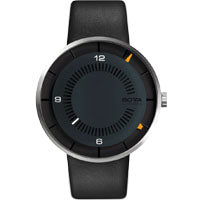
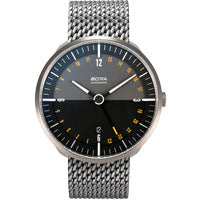


1986


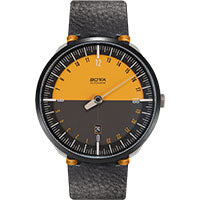
A one-hand watch is a watch that displays the hours and minutes using just a single hand. On the BOTTA UNO, the original modern one-hand watch, the hour hand moves continuously across a finely graduated 12-hour scale. Its position therefore indicates not only the hour, but also the minutes that have already elapsed.
The principle is similar to that of an analog measuring instrument, where intermediate values can also be read from the position of a single hand. The hand’s slow movement creates a calm and clearly structured representation of time. Unlike conventional watches with several hands moving at different speeds, time is perceived as less hectic and more as a continuous flow.
A 12-hour one-hand watch is read by looking at the position of its single hand on the scale. The hand moves continuously across the dial, completing one full rotation every twelve hours at the same speed as the hour hand of a conventional watch.
On the BOTTA UNO, the longest markers indicate the full hours, the medium-length markers the half hours, the slightly shorter markers the quarter hours, and the shortest markers five-minute intervals. After a short period of familiarization, the current time can be read intuitively and, when needed, to an accuracy of approximately five minutes.
Yes, a one-hand watch is very practical for everyday use. For most daily situations, a reading accuracy of around five minutes is more than sufficient. Many wearers quickly become accustomed to the reduced display and then find it particularly clear, intuitive, and pleasantly calm.
For the rare occasions when the exact minute or second matters, a smartphone provides a precise complement at any time.
The BOTTA UNO has only one hand because it deliberately reduces the display of time to its essentials. The single hand indicates both the hours and the minutes, allowing the wearer to intuitively understand the current point within the hour.
This significantly reduces the amount of information displayed on the dial. Attention shifts away from individual minutes or seconds and toward the broader passage of time. In this way, the BOTTA UNO encourages a calmer, more conscious, and more self-determined approach to time.
The modern one-hand watch was developed in 1986 by German product and watch designer Klaus Botta. With the BOTTA UNO, he applied the one-hand display principle to a modern wristwatch for the first time, creating an independent and reduced concept of time.
The UNO displays the hours and minutes with just one hand. This display principle, developed in 1986, remains the conceptual foundation of BOTTA’s one-hand watches to this day.
A one-hand watch is technically just as precise as a conventional multi-hand watch. On the BOTTA UNO, the scale is divided into five-minute intervals, allowing the time to be read to within a few minutes in everyday use.
The watch’s rate accuracy depends on the quartz or automatic movement used. Only the display of time is deliberately reduced: instead of showing minutes and seconds separately, the single hand presents the current time in a clear and concise format.
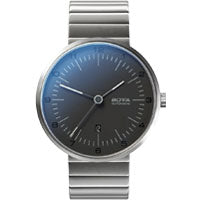
The difference between a quartz and an automatic one-hand watch lies in how the movement is powered. A quartz watch is powered by a battery and controlled electronically. It is particularly precise, convenient for everyday use, and requires very little maintenance.
An automatic one-hand watch, by contrast, features a purely mechanical movement that winds itself through the motion of the wrist. It combines the reduced one-hand display with traditional watchmaking and the special fascination of visible mechanics.
Which version is the better choice therefore depends primarily on personal preference: quartz stands for precision and uncomplicated convenience, while automatic represents mechanical tradition and emotional value. You can find further information in our blog article Mechanical Watch vs. Quartz Watch.
The difference between a 12-hour and a 24-hour one-hand watch lies in the period displayed and the movement of the hand. On a 12-hour one-hand watch such as the BOTTA UNO, the hand travels around the dial twice a day. The scale represents twelve hours at a time and allows the time to be read intuitively to within a few minutes.
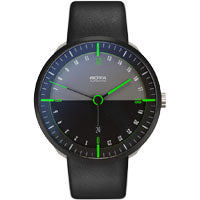
On a 24-hour one-hand watch such as the BOTTA UNO24, the hand moves around the dial only once per day. This makes the entire course of the day visible at a glance. The sun-synchronous arrangement of the 24-hour scale also shows the position of the current time within the natural rhythm of day and night.
A one-hand watch is ideal for people who appreciate clear design, deliberate reduction, and a more relaxed approach to time. It particularly appeals to those who prefer to read the time intuitively without constantly focusing on individual minutes or seconds.
Despite its reduced display, the time remains sufficiently precise for everyday use. Its calm presentation focuses on what truly matters, encouraging a more conscious, composed, and self-determined approach to time.
What makes a BOTTA one-hand watch special is its consistent combination of intuitive time display, functional design, and a more conscious approach to time. Since Klaus Botta developed the modern one-hand watch with the UNO in 1986, this concept of time has been continuously refined.
BOTTA one-hand watches are characterized by clearly structured dials, intuitive readability, and a focus on the essentials. The result is a distinctive timepiece that combines precise design with a calm and self-determined perception of time.