

Your day is packed, the week passes surprisingly quickly, and in the end, there is that uneasy sense of having done a lot but truly experienced very little. You are not alone. More and more people share this experience – and they all arrive at the same realization: The real problem is not that we have too little time. Every person has exactly 24 hours per day. No more, no less.
What has changed is our relationship with time. Many of us no longer experience time as a space to shape, but as a constant ticking. As something that drives us through the day, dictated by external forces. And this is exactly where the key to change lies.

When time becomes nothing but a ticking rhythm
An honest look at your daily life is enough. Appointments, notifications, interruptions, emails, messages, calendar alerts, to-do lists. You know it well. Digital systems help us coordinate tasks faster and make information available at any time. At the same time, they create a constant state of reactivity that exhausts us.
As a result, time no longer appears as a continuous flow, but as a sequence of small fragments. An appointment here, a message there, a quick glance at your smartphone, the next reminder, the next context switch. Do you notice how even reading this list creates a sense of restlessness? This is how an experience of time emerges that no longer feels natural, but artificially compressed.
You are constantly busy, but rarely truly present. You often look at the clock – and yet understand your own time less and less. This overload of digital stimuli changes not only how you organize your schedule, but your fundamental relationship with time itself.
Stress is only the visible surface. Beneath it often lies something deeper: a loss of inner orientation. When you experience time only as a ticking driver, you easily lose touch with its true quality. Hours become units of completion. Days become containers for tasks. Weeks pass without truly taking place within you.
This is more than an organizational problem. It is a perceptual problem. Because time is not only measured. Time is experienced. And this experience is closely linked to attention, awareness, and inner clarity. When your attention is constantly fragmented, your sense of time fragments as well. Then days feel both hectic and empty at the same time. A lot happens – but little remains.
From a psychological perspective, time perception is not a rigid system. It changes with your state. Think about it: minutes can feel long or short. The sense of time emerges where perception gains depth.
When you are fully engaged in something, when you work with focus, have a meaningful conversation, take a walk, read, create, or reflect, your relationship with time changes. It does not slow down in a physical sense. But it becomes tangible again. Your sense of time does not return through more control, but through more conscious perception.

Perhaps you have also tried to solve the problem through efficiency. Planning more precisely, structuring more strictly, optimizing processes – in the hope of gaining more control again. In the short term, this can help. In the long term, it is often not enough. Because those who only organize faster usually remain within the same framework: time as something that must be managed.
Clarity matters more than speed
A more conscious approach to time begins at a different point. Not with speed, but with clarity. Clarity means recognizing what truly matters. Distinguishing the important from the urgent. Not confusing interruptions with relevance. Giving your day an inner structure again.
Time competence arises where you stop following every external rhythm and regain your own orientation.
Returning to nature plays a surprisingly important role. Not in a romantic sense, but as a reconnection with natural rhythms. Your organism has followed biological cycles for thousands of years – daylight, seasons, circadian rhythms. Digital timing largely ignores these natural patterns. It replaces organic flows of time with artificial intervals.
That is precisely why analog anchors are becoming increasingly important again. Not out of nostalgia, but because they create a counterbalance. They take you out of the constant reactive mode and make perception tangible again. A notebook demands a different kind of interaction than an app. A consciously designed workspace changes the quality of your attention.
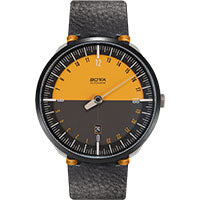
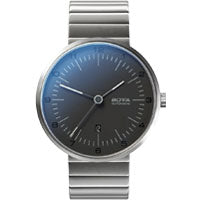
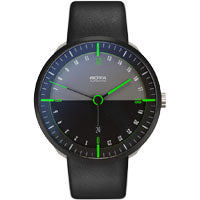
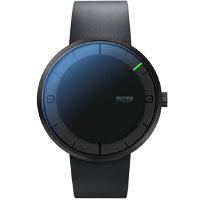
An analog way of telling time can serve as a quiet reminder that time is not only made of minutes and seconds, but of meaning, rhythm, and perspective. What matters is the mindset it supports.

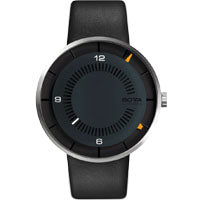
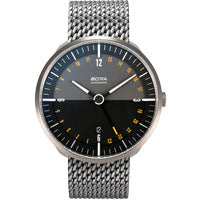
This is where it becomes clear why some watches can be more than mere functional objects. They can help cultivate a different relationship with time. A reduced display relieves your eyes. A logically structured scale provides orientation. An alternative way of displaying time shifts your focus away from hectic moments and toward the bigger picture.
BOTTA has been pursuing this approach since 1986. Not as a decorative idea, but as a consistent philosophy of time. The modern one-hand watch was born from the question of whether less display could lead to more calm and clarity. The sun-synchronous 24-hour display follows the idea of making the entire day tangible again. BOTTA therefore stands not only for extraordinary watches, but for a more conscious, logical, and human-centered way of dealing with time.
The path back to a natural sense of time rarely begins with something spectacular. It usually starts with small, conscious changes in your daily life:
- Consistently reduce interruptions: Create dedicated time slots without digital distractions.
- Design transitions in your day consciously: Use short rituals between activities.
- Lift your gaze from the screen more often: Establish analog anchor points.
- Think in time spans rather than just intervals: See the day as a whole.
- Choose objects that create calm instead of stimulation: Your environment shapes your experience of time.
It sounds simple. And that is exactly where its power lies. Time does not become valuable only when it is perfectly planned. It becomes valuable when it is consciously experienced.
Your time is your life. Today, many people do not lose time itself, but their connection to it. They experience time as pressure, not as a space for living. As a ticking rhythm, not as a space for shaping. To regain your sense of time, you need not only better planning, but a different understanding.
Perhaps your more conscious approach to time does not begin with another app, but with a different perspective. Self-determination in how you use your time begins when you stop following constant external rhythms and start developing your own culture of time.
If you are interested in a more conscious way of dealing with time, discover the BOTTA philosophy and timepieces that do not accelerate, but provide orientation. Watches that show that time is more than minutes and seconds – it is meaning, rhythm, and perspective.