






Why Our Most Valuable Currency Isn’t in Our Bank Account
Imagine waking up every morning to find €86,400 deposited into your bank account. There’s just one catch: whatever you don’t spend by midnight is gone forever. What would you do? Most likely, you’d invest every single cent consciously.
This is exactly how time works. Every day, you are gifted 86,400 seconds — and whatever you don’t use is lost forever. Unlike money, time cannot be saved, stored, or reclaimed. It is the only truly democratic resource: every person receives exactly the same amount each day.
The decisive difference lies not in the quantity, but in the quality of the investment.
Time as a Portfolio – What Do You Invest In?
In the financial world, we speak of portfolio management — the strategic allocation of capital across different asset classes. Applied to your time, this means one simple question: Which areas of your life receive your most precious resource?
Most people think of time management as to-do lists and efficiency hacks. But the truly essential question is this: Are you investing your time in activities that generate sustainable long-term value?
Let’s look at a few “asset classes” for your time:
-
High-risk investments: Activities that offer short-term gratification but create little long-term value (endless social media scrolling, passive media consumption)
-
Dividend stocks: Activities that reliably generate positive returns (exercise, healthy nutrition, nurturing important relationships)
-
Growth stocks: Activities with strong development potential (learning new skills, future-oriented personal projects)
-
Long-term bonds: Stable investments in your core values (family, health, personal development)
The key insight: Just as with financial investments, time follows the principle of compound interest. Small but consistent investments in the right areas can lead to exponential results over the years.
Schedule the “Big Rocks” First
The American time management expert Stephen Covey illustrated this principle with a powerful demonstration. He filled a glass jar with large stones and asked the audience whether it was full. When they agreed, he added pebbles, which filled the gaps between the stones. Then came sand — and finally water.
The lesson: Had he started with the sand, there would have been no room for the big stones.
The “big rocks” are your most important time investments — the activities that give your life meaning and direction.
If you don’t schedule them first, your life fills up with trivialities (the “sand”), leaving no room for what truly matters.
From Theory to Practice: Conscious Time Investment
After analyzing, simplifying, and focusing your time in the previous time impulses, the next step is the active design of your personal “time portfolio.” Here are some concrete approaches:
1. Identify Your Big Rocks
Which three to five areas of life are fundamentally important to you? Typical examples include:
-
Health and vitality
-
Meaningful relationships
-
Professional fulfillment and development
-
Personal growth
-
Creativity and self-expression
2. Define Your Expected Return
What does “value creation” mean to you personally? For some, it’s happiness and contentment; for others, knowledge, competence, or deep connection.
Your definition of “return” is as individual as your personality.
3. Plan Conscious Time Investments
Block fixed time slots in your calendar for your priorities — before daily life crowds them out. A helpful rule of thumb: at least 60 focused minutes per week for each of your Big Rocks.
4. Review Your Portfolio Regularly
Just like financial investments, your time portfolio should be reviewed periodically. Which activities deliver the desired “returns”? Where would rebalancing make sense?
The Time Investment Matrix: A Practical Tool
To evaluate your time investments, you can use a simple matrix:
-
Horizontal axis: Short-term gratification (low to high)
-
Vertical axis: Long-term value (low to high)
The Four Quadrants
-
High long-term value, high short-term gratification:
Ideal time investments (e.g. flow experiences, meaningful work, high-quality time with loved ones)
-
High long-term value, low short-term gratification:
Valuable but demanding investments (e.g. learning, training, difficult conversations)
-
Low long-term value, high short-term gratification:
Tempting time wasters (e.g. excessive social media use, binge-watching)
-
Low long-term value, low short-term gratification:
Pure time waste (e.g. unnecessary meetings, conflicts, worrying about things you cannot change)

Your goal: Maximize time in quadrants 1 and 2, minimize quadrant 4, and be selective with quadrant 3.
Time Is Not Money – It’s Much More
Contrary to the common saying “time is money,” conscious time investment is about something far more fundamental:
Time is life. Every minute you invest is a piece of your life you will never get back.
Realizing that time is our most valuable asset can feel unsettling at first. But it also carries a liberating message: you have both the freedom and the responsibility to shape your time according to your own values.
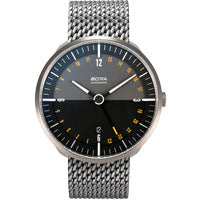
A BOTTA watch on your wrist can be a valuable companion in this process — not merely as a timekeeper, but as a daily reminder of the value of every minute. Our UNO single-hand watches, in particular, convey a slower, more mindful perception of time, helping you appreciate the present moment.
Concrete Impulses for This Week
-
Create your personal time investment strategy:
Define your three most important Big Rocks and schedule at least 60 focused minutes for each in the coming week -
Conduct a 24-hour experiment:
Treat your time like money for one day. With every activity, ask yourself: “Is this the best investment of my time?" - Identify your time thieves:
-
Establish a daily high-return ritual:
Reserve 15–30 minutes each day for an activity that yields particularly high long-term “returns” for you -
Reflect on the weekend:
Take 10 minutes on Sunday to review your time investments from the past week and plan the week ahead.
Which activities in your daily life fall into quadrant four (low value, low gratification)? How can you reduce or eliminate them?
Reflection question:
What will I consciously invest 60 focused minutes in this week?
The answer to this question could mark the beginning of a lasting transformation in how you experience time. Because ultimately, it’s not the clock that determines your time — but the values and priorities according to which you invest your most precious resource.
FAQ: Investing Time
How does time investment differ from classic time management?
Traditional time management often focuses on efficiency and task completion. Time investment, by contrast, treats time as a valuable resource and emphasizes the quality and long-term impact of activities. It’s less about doing more in less time and more about consciously investing the time you have in areas that create lasting value.
How can I tell if an activity is a good time investment?
A good time investment meets three criteria:
-
It aligns with your personal values and goals
-
It creates long-term value (for your health, relationships, knowledge, or well-being)
-
It gives you more than you invest — whether through joy, fulfillment, growth, or tangible results
How do I deal with “necessary evils” that bring neither joy nor long-term value?
Not all activities can be meaningful or enjoyable. For these “necessary evils,” there are three strategies:
-
Minimize them through simplification and automation
-
Combine them with pleasant elements (e.g. listening to a podcast while cleaning)
-
View them as indirect investments that create space for more valuable activities
How do I find the right balance between short-term pleasure and long-term value?
A healthy time investment strategy includes both dimensions. Consciously plan “return activities” for long-term value and “dividend activities” for immediate enjoyment. The ideal balance is individual and depends on your life situation. As a rule of thumb, aim for activities that offer both short-term gratification and long-term value.
How can I prevent urgent tasks from constantly displacing my important time investments?
Urgent tasks tend to crowd out important ones. Protect your valuable time investments by:
-
Blocking fixed calendar slots for your Big Rocks
-
Setting clear boundaries and communicating them
-
Reducing distractions during these reserved times
-
Regularly reviewing whether your actual time use aligns with your priorities