



Imagine arranging to meet someone not at 2:30 p.m., but simply "in the early afternoon". To us, that sounds imprecise. For people in earlier centuries, it was perfectly normal. This small change in perspective alone reveals how profoundly timekeeping has shaped not only our everyday lives, but also the way we think.
The history of timekeeping is therefore much more than the history of technical devices. It tells the story of how humanity has sought to bring order to the course of the day, gain a sense of certainty, coordinate work, navigate distances and ultimately measure even the smallest fractions of a second. And it leads to a question that has become surprisingly relevant again today: How much precision do we really need?
The First Timekeepers: Shadows, Water and Fire
In the beginning, there was no clockwork, only nature. The position of the sun, the length of shadows, the alternation of day and night, and the recurring seasons. As early as around 3500 BC, people in ancient Egypt used the gnomon, a simple upright rod whose shadow made the passage of the day visible. The sundial developed from this principle. Source: Encyclopaedia Britannica, "Sundial".

But the sun has one disadvantage: it only works in daylight. Early civilizations therefore looked for other solutions. Water clocks, also known as clepsydras, were already known in Egypt during the second millennium BC and later in Greece. The principle was as simple as it was ingenious: water flowed steadily out of a container, and the falling water level indicated how much time had passed. Source: Encyclopaedia Britannica, "Water clock".
Later came candle clocks and hourglasses. A candle with markings transformed burning time into measurable time. The hourglass made time visible as the sand slipped away. This was more than technology. It was almost a metaphor for the human perception of time itself.
All these early instruments had one thing in common: they measured time approximately. Hours were sufficient. Nobody needed seconds. Time was not yet a rigid grid, but a rhythm.
When Time Began to Tick: The Mechanical Clock Changes the World
In late 13th-century Europe, something fundamentally new emerged: the mechanical clock. Around 1280, clockmakers developed the first mechanical clocks with gear trains, driven by weights and regulated by an escapement. Time was no longer simply observed or allowed to pass, but actively divided into regular intervals. Source: Encyclopaedia Britannica, "Clock".
The earliest tower clocks generally displayed only the hour. That was sufficient for monasteries, markets and towns. What mattered was not the level of detail, but reliability. Time became public. It was no longer determined solely by the sky, but visibly displayed at the centre of social life.
The next major breakthrough came in 1656 with Christiaan Huygens' pendulum clock. The pendulum drastically reduced daily timekeeping deviations. Errors that had previously been measured in minutes could now be measured in seconds. What sounds modest today was an enormous advance at the time. Source: Encyclopaedia Britannica, "Pendulum clock".
From that point onwards, it was not only the clock that changed, but also the people who used it. Those who can measure more precisely begin to plan more precisely. Time gradually evolved from a natural framework into a technical quantity.
Precision at Sea: Why Accurate Clocks Could Save Lives
The value of accurate timekeeping became particularly evident at sea. For centuries, sailors could determine their latitude relatively reliably, but not their longitude. To do so, they needed an accurate reference time. Without it, determining their position remained uncertain, often with dramatic consequences.
In 1714, the British Parliament offered a substantial prize for solving this problem. John Harrison, an English clockmaker without a traditional academic background, spent decades developing marine chronometers that remained remarkably accurate even under the harsh conditions at sea. His H4 chronometer from 1759 became famous for demonstrating that precise timekeeping could make navigation safer. Source: Royal Museums Greenwich.

This illustrates a recurring pattern in the history of technology: precision does not arise from an abstract fascination with accuracy, but because it serves a purpose. Timekeeping became more accurate because people needed greater accuracy.
Industrialisation and the Wristwatch: Time Becomes Personal and Global
Industrialisation changed the role of time once again. It was no longer merely about orientation, but about coordination. Railways needed to operate according to timetables. Factories had to organise shifts. Cities needed to agree on common time standards.
In 1884, the International Meridian Conference in Washington established the Greenwich Prime Meridian as the global reference point. This laid the foundations for the modern system of time zones. Time became internationally standardised.
At the same time, clocks became more personal. The wristwatch evolved from the pocket watch. Initially regarded as a largely decorative object, it proved practical in the early 20th century and gradually became part of everyday life. Source: Encyclopaedia Britannica, "Watch".
From then on, people carried time directly on their bodies. This was not merely convenient. It had far-reaching cultural consequences. Time became constantly available. And what is constantly available also begins to make constant demands on us.
The Maturity of the Mechanical Watch: The Last 100 to 150 Years
This period is particularly revealing for our modern understanding of watches. During the late 19th and throughout the 20th century, the mechanical watch reached a level of maturity that continues to fascinate us today. Movements became smaller, more reliable, more shock-resistant and more accurate. Materials improved, as did manufacturing methods. Delicate instruments evolved into robust everyday companions.
The mechanical watch was now more than just technology. It had also become part of our culture. It expressed attitudes, personal taste and an individual's relationship with time. Some watches represented status, others functionality, and still others clarity of design.
This is where the history of watches becomes truly interesting. From the outside, many watches look similar: case, dial, hands. Yet internally and conceptually, they can offer entirely different answers to the same question: How should time be represented?
For precisely this reason, the history of the watch is not merely a story of increasing precision, but also a story of different ways of thinking.
Quartz and Atomic Clocks: Precision Beyond Everyday Needs
In 1927, Warren Marrison developed the first quartz clock at Bell Laboratories. An electrically excited quartz crystal oscillates with exceptional regularity, providing a significantly more precise timing reference than many conventional mechanical systems. Sources: Encyclopaedia Britannica, "Quartz clock", and NIST.

From the 1970s onwards, quartz technology radically transformed the global watch market. Watches became more affordable, more accurate and widely available. For traditional watchmaking, this marked a major turning point. For everyday life, it was a triumph of functionality.
But technological development continued. The first modern atomic clock was built in 1955. Since 1967, the second has officially been defined using exactly 9,192,631,770 oscillations associated with the caesium-133 atom. Sources: Physikalisch-Technische Bundesanstalt and NIST.
Humanity had now achieved a degree of precision far beyond everyday experience. For satellite navigation, telecommunications and fundamental scientific research, this is indispensable. Yet for our own lives, a different question arises: Does time become more valuable simply because we can measure it more precisely?
It is precisely at this point that the technical history of timekeeping becomes a philosophical one.
How Timekeeping Has Changed Our Sense of Time
As clocks became more accurate, they increasingly changed our relationship with time. In the past, time was primarily a framework. Today, it is often a rigid grid. People once asked: Is it light yet? Is it midday? How far has the day progressed? Today, we focus on minutes, appointments, time slots, deadlines and response times.
This is not simply progress. It is also an intensification of everyday life.
Humanity has learned to divide time into ever smaller units. But this has not automatically enriched our experience of time. Quite the opposite: many people experience modern precision not as freedom, but as pressure. Clocks measure more accurately, yet people often feel less in control.
Here lies the central tension of our time. Technologically, we can measure time more precisely than ever before. Yet as human beings, we increasingly long for perspective, rhythm and inner order.
Returning to a Human Scale
This is precisely why a new question has emerged: not merely how accurately a watch keeps time, but how meaningfully it represents it.
This does not mean turning back the clock. Nobody wants to abandon precision in aviation, medicine or navigation. But different standards apply to a watch worn on the wrist than to an instrument in a laboratory. Here, it is not only about measurement, but also about perception.
A watch can represent time in a way that creates pressure. Or it can represent time in a way that provides orientation.
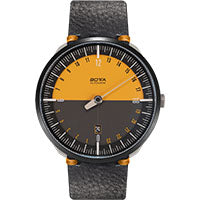
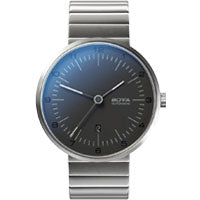
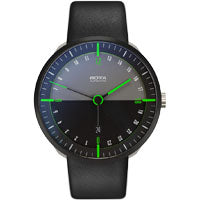
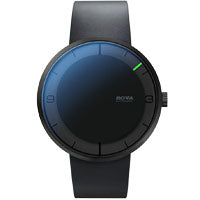
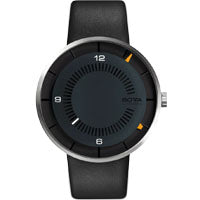
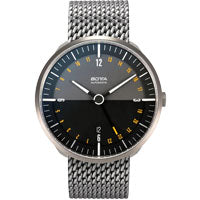
This is where a human-centred philosophy of time becomes relevant. When a single-hand watch focuses on the progression of the hour rather than the counting of individual minutes, this is not a technical weakness, but a conscious decision. When a 24-hour watch makes the entire day visible as one continuous cycle, our perspective shifts: away from isolated moments and towards the bigger picture.
This is where a brand like BOTTA fits naturally into the history of timekeeping. Not as an outsider, nor as an advertising interruption, but as a response to a development that has evolved over centuries. When technical precision has long since reached extraordinary levels, the next meaningful innovation becomes a human one: making time understandable, tangible and meaningful again.
Two Paths of Modern Timekeeping
Today, two paths of development run parallel in the world of timekeeping.
One continues to push the boundaries of precision. It is indispensable to science and technology. Without it, there would be no satellite navigation, no synchronised data networks and no modern high technology.
The other focuses on people. It is concerned less with thousandths or millionths of a second than with clarity, calmness, readability and our relationship with the day. It asks not only, "How accurate is this watch?", but also, "How does this watch affect the way I experience time?"
Both approaches are valid. But they serve different purposes.
That is precisely why watches should not be judged solely by their measuring performance. A watch can be technically brilliant and still offer little sense of orientation. And it can be deliberately reduced, developing a deeper quality precisely through its simplicity.
Reducing complexity is the new luxury of our time. This statement describes more than a design philosophy. It also summarises an insight gained from history.
Conclusion: The Most Mature Form of Timekeeping Is Not Necessarily the Most Precise
The history of timekeeping begins with shadows and water, continues through gears, pendulums and chronometers, and leads to quartz resonators and atomic oscillations. It is undoubtedly a story of progress. But it is also a story of the growing distance between technical measurement and human experience.
Perhaps the most mature form of timekeeping therefore does not lie simply in ever greater precision. Perhaps it lies in using precision where it is necessary, and deliberately reducing it where it places more demands on people than it offers benefits.
Not every watch needs to do everything. But a good watch should fulfil the essential purpose: it should not merely display time, but present it in a form that suits the human being.
Because your time is your life.
Sources and Further Reading
Physikalisch-Technische Bundesanstalt (PTB): Information on time, frequency, atomic time and the definition of the second.
https://www.ptb.deNational Institute of Standards and Technology (NIST): Fundamentals of modern atomic clocks and the realisation of the SI second.
https://www.nist.govRoyal Museums Greenwich: John Harrison, marine chronometers and the longitude problem.
https://www.rmg.co.ukEncyclopaedia Britannica: Articles on sundials, water clocks, mechanical clocks, pendulum clocks, wristwatches and quartz clocks.
https://www.britannica.comGerman Watch Museum Glashütte (Deutsches Uhrenmuseum Glashütte): Articles on the development of watchmaking and historical timekeeping.
https://www.uhrenmuseum-glashuette.comDavid S. Landes: Revolution in Time: Clocks and the Making of the Modern World. Harvard University Press.

1 comment
Hallo Klaus,
Das ist wirklich eine tolle Abhandlung der Geschichte über Zeitmessung.
Vorallem die Differenzierung über dem was möglich ist und dem was der Mensch braucht fand ich persönlich sehr wertvoll. In jedem Fall ein sehr professioneller Artikel, der es wert ist abgedruckt zu werden. Grüße Klaus