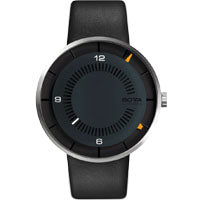
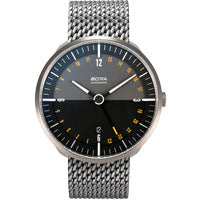


Forty years is an unusually long time for a product. Trends, materials and technologies change. What remains is rarely a form, but rather a compelling idea.
The UNO is one of these exceptions. Since its development in 1986, it has been continuously refined in technical, ergonomic and design terms. What has remained is the idea from which it originated. And this idea is more relevant today than ever.
The question was more important than the watch
In 1986, I did not set out to design an extraordinary watch. I was concerned with a more fundamental question: "Why do we actually represent time the way we do?"
With industrialisation, watches became increasingly precise. Hours, minutes and seconds determined timetables, machines and working processes. Yet greater precision does not automatically provide people with greater orientation. We do not experience our day in seconds, but in periods of time: morning, midday, early evening. Our perception follows a rhythm, not the seconds hand.

The decisive question was therefore:
What would a watch need to look like if it were based on human perception rather than the logic of the machine?
Reduction creates orientation
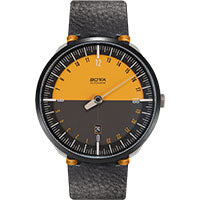
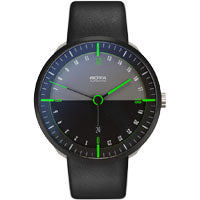
This insight gave rise to the UNO. One hand. A specially developed scale. Ideal for making the progression of time intuitively comprehensible. The slowly moving hand functions like the indicator on a measuring instrument. Every moment has a clearly defined position. Time is not divided into ever smaller units, but becomes visible as a continuous progression. The display therefore feels surprisingly natural – because it closely reflects the way we perceive time.
The first modern one-hand watch
The earliest mechanical clocks also had only one hand. However, this was due to the technical limitations and cultural circumstances of their time. The movements were not yet precise enough to provide a more detailed display. Moreover, there was simply no need for time to be divided into even smaller units.

The UNO was created from the opposite motivation. It was not technical limitations that led to the use of a single hand, but the deliberate decision to reduce complexity. In this way, the historical one-hand principle became an independent design concept for the first time. Technical necessity became a matter of design conviction. This is precisely why the UNO is the first modern one-hand watch.

Good products mature
Many products change primarily in appearance. Colours change, forms follow the spirit of the times, and new models replace old ones. The UNO developed differently. For four decades, the same fundamental idea has been consistently refined. The scale became more sophisticated in its graphic design, readability became more intuitive, and the case more ergonomic.
Over eight stages of development, the original matt chrome-plated brass case evolved into today’s TriTitan case. Double-domed sapphire crystal with anti-reflective coating on both sides, modern Swiss movements and high-quality straps gradually brought the UNO to its present level of maturity.
Not into a different watch. But into a better UNO.
For us, tradition means continuous development
One quotation describes our approach to development particularly well:
“Tradition is not the worship of ashes, but the preservation of fire.”
The aim is not to preserve past solutions, but to keep the original idea alive.
Everything may change if it strengthens this idea. Nothing is changed merely to appear new.

The original
Today, there are numerous modern one-hand watches. The fact that they have become a watch category in their own right confirms the strength of the original concept. The UNO remains the original.
Not only because it was the first modern one-hand watch, but because it still follows the same conviction today: to present time in a clearer, more natural and more human way.
Perhaps, in an increasingly complex world, we do not need even more precise displays. Perhaps what we need most is greater orientation.
That is exactly what the UNO was developed for forty years ago.
And that is precisely why it is more relevant today than ever.
Klaus Botta